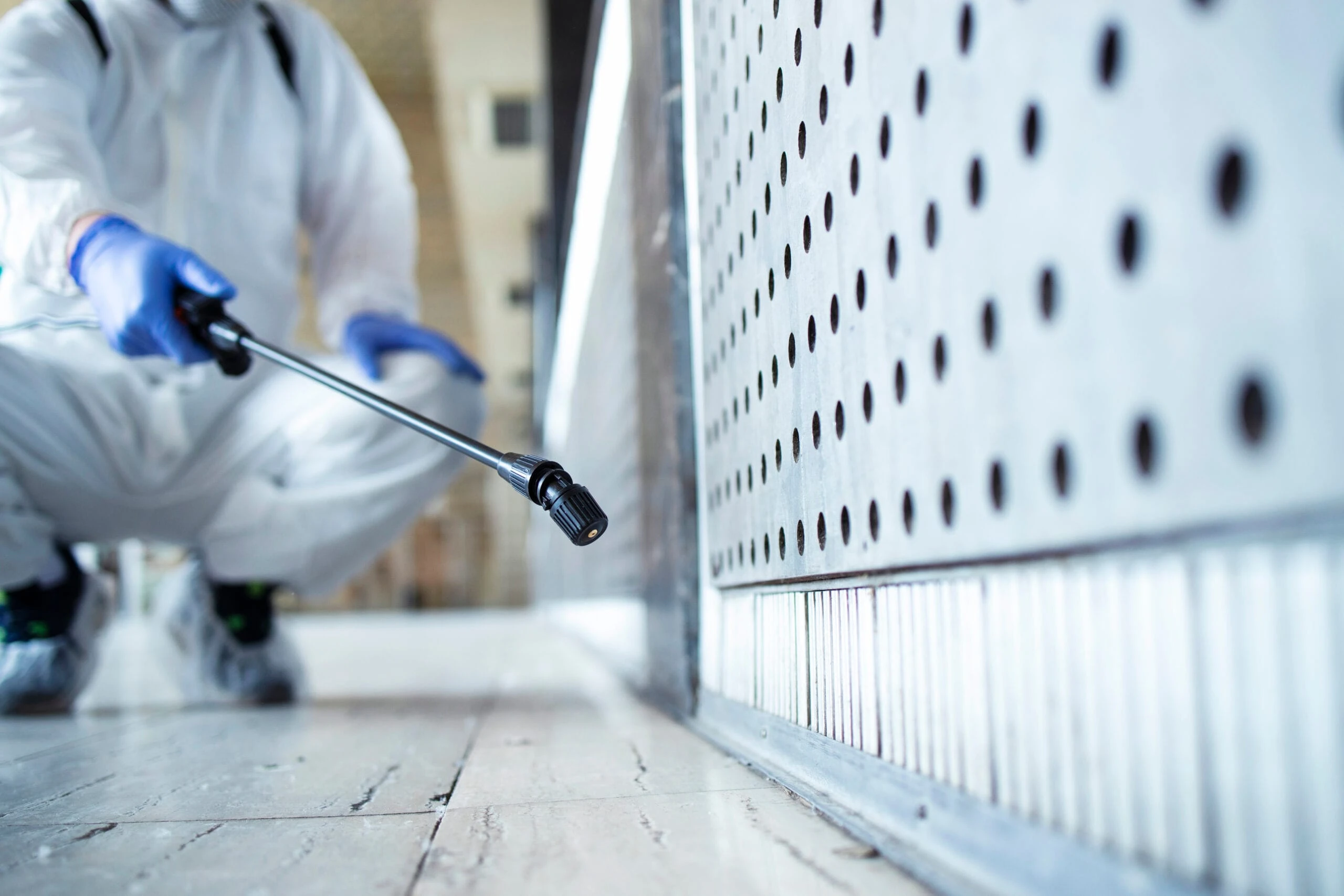
Service · Rodent treatmentHigh riskRattus norvegicus, Rattus rattus, Mus musculus
Rodent Control across the UAE
Norway rats, roof rats and house mice that contaminate food, chew wiring and spread leptospirosis across UAE villas, warehouses and food premises. 6-month pest-free guarantee.
Active · Year-round indoor activity in air-conditioned UAE buildings, Outdoor breeding peak October to April when night temperatures fall below 28°C
Rodents are the most service-intensive pest in the UAE. Three species dominate: the Norway rat (large, brown, sewer-bound), the roof rat (smaller, agile, lives in false ceilings of newer towers), and the house mouse (tiny, breeds in pantries). Older neighbourhoods — Deira, Karama, Al Quoz, Mussafah and the labour-camp belt of Sonapur — carry chronic rat pressure because of dense sewer infrastructure, Tetra Pak spillage at wholesale food markets, and open loading bays. Newer Marina, JLT and Business Bay towers face a different problem entirely: roof rats climb internal risers and drop into apartments from AC voids and false ceilings at night. Mice slip through gaps the width of a pencil into pantries and under-counter kitchen units. The risks are not theoretical — leptospirosis (Weil's disease) from rat urine, Salmonella from food contamination, hantavirus from disturbed droppings, and electrical fires from chewed wiring are all documented in UAE hospital and Civil Defence records. PestMan uses a layered programme: tamper-resistant exterior bait stations (EPA T4 / EN 16636 equivalent) on a numbered map, indoor snap traps and glue boards near food zones, steel-wool and foam sealing of every entry point larger than 6 mm, and HACCP / Tadweer monthly logging for restaurants, hotels and warehouses — all backed by a 6-month pest-free guarantee with unlimited free call-outs.
Female produces up to 60 pups a year — a single missed mouse becomes a full infestation in 90 days
How it works
Our treatment process
01
Survey & Species ID
Map droppings, gnaw marks and rub marks to identify Norway rat vs roof rat vs house mouse and trace travel routes between feed and harbourage.
02
Bait Station & Trap Plan
Position numbered exterior bait stations, indoor snap traps and false-ceiling glue boards on a documented map signed off with the client before work begins.
03
Entry-Point Sealing
Seal every gap larger than 6 mm with steel wool, copper mesh and rodent-grade foam — including AC penetrations, weep holes and pipe collars.
04
Follow-up Programme & 6-Month Warranty
Four follow-up visits across the warranty period (monthly for commercial), with WhatsApp activity logs and free unlimited call-outs across 180 days.
Service tiers
Our rodent services
01
Residential
Villa and apartment programmes covering exterior bait stations, false-ceiling and pantry treatment, and full entry sealing — 6-month pest-free guarantee with four follow-ups.
02
Commercial (HACCP / Tadweer)
Restaurants, hotels, warehouses and supermarkets get a monthly maintenance contract with numbered bait-station maps, signed service tickets, activity trend graphs and audit-ready documentation accepted by Dubai Municipality, ADAFSA and Sharjah Municipality.
03
Emergency 24/7
Same-day response for rats in the false ceiling, a chewed sleeping-area cable, a positive sighting before a HACCP audit, or a dead-rodent odour in the AC duct.
rodent control guide
Everything you should know
A short, honest field guide — what we look for, how we treat, and how to keep them out for good.
How to identify them
Norway rat: 200–270 mm body, brown, blunt nose, tail SHORTER than body, 18–22 mm capsule droppings
Roof rat: 160–200 mm body, black-brown, pointed nose, tail LONGER than body, 12–13 mm spindle droppings
House mouse: 70–100 mm body, light brown, large ears, 3–7 mm rice-grain droppings
Gnaw marks on plastic pipes, cardboard and wood — fresh gnawing is light coloured, ages to grey-brown
Greasy 'rub marks' along baseboards and pipe runs where rodents brush the wall on regular travel routes
Strong ammonia smell from urine concentration in nest voids
Signs of infestation
Droppings in pantry corners, under sinks and along storeroom skirting
Sound of scratching or scuttling in the false ceiling between 11pm and 4am
Chewed corner of a flour bag, baby formula tin or pet kibble container
Greasy rub marks on lower 10 cm of walls along regular rodent runs
Dead rodent odour from inside AC ducts or behind a kitchen unit
Pet (especially cats and small dogs) fixating on the same spot in a wall every evening
Health & safety risks
Leptospirosis (Weil's disease) from contact with rat urine on water or food surfaces — multiple UAE A&E cases yearly
Salmonella, E. coli and Hymenolepis tapeworm contamination of pantry food and prep counters
Hantavirus exposure when sweeping or vacuuming dry droppings — aerosolises the virus
Electrical fires from chewed wiring — UAE Civil Defence attributes a measurable percentage of villa fires to rodent damage
Bite risk for sleeping infants in heavily infested apartments
Asthma and allergic rhinitis triggered by rodent dander and urine protein in HVAC systems
The questions we hear most about rodent control jobs in the UAE.
My neighbour says exterior bait stations attract MORE rats to the area — is that true?
It's the single most repeated rodent myth in UAE residential WhatsApp groups, and it's wrong. Tamper-resistant exterior bait stations are 'passive' tools — the bait inside has no broadcast attractant. Rats already living within their 30–50 m foraging radius will encounter the station on their nightly travel and feed; rats living further away have no way of knowing the bait exists. What CAN attract more rats to your villa is open kitchen waste, dripping AC condensate, pet food left out, and palm fronds touching the wall — none of which are caused by professional baiting. The stations are required by EN 16636 to be locked, anchored and labelled because of child and pet safety, not because they're somehow drawing rats from across the neighbourhood.
There's a rat in the wall — if I poison it, will it die in there and stink?
It's a real risk and the reason we don't deploy interior rodenticide as a first-line tool in villas and apartments. Anticoagulant rodenticide takes 4–7 days to kill — long enough for the rat to die deep inside a wall void or above a false ceiling where retrieval means cutting drywall. Snap traps and glue boards placed indoors avoid this entirely because the rodent dies on the device, in the open, and you message us a photo and we collect it. Where we do use interior rodenticide (occasionally in commercial roof voids), we use bromadiolone variants that drive the rodent to seek water — meaning they typically die outside the building, near the bait station they fed at. For your villa, expect a snap-trap and glue-board only programme indoors.
There's a horrible smell from the AC vent — could it be a dead mouse in the duct?
Almost certainly yes — and it's the second most common rodent call we get from Marina, JLT and Business Bay apartments. A dead mouse in a sealed duct produces a sweet putrefaction smell that peaks at days 3–5 and fades after 14–21 days. Rather than wait it out, our duct-retrieval team uses an inspection borescope through the nearest vent, locates the carcass, removes it via the access panel, and treats the affected duct section with enzymatic odour neutraliser (not just fragrance, which masks but doesn't degrade the smell molecules). Same-day service through our emergency line. Don't seal the vent or run air freshener — both make the diagnosis harder when we arrive.
Can a single rat really cause an electrical fire in a villa?
Yes — UAE Civil Defence and major insurers track rodent-attributed wiring damage as a recognised category of villa fire cause. A rat's incisors grow continuously and need to be worn down by gnawing; PVC cable insulation has the perfect resistance and softness. Once the insulation is breached, an arc fault at the exposed copper can ignite dust, paper or wood inside a wall void — often hours or days after the rodent has moved on. Roof-rat damage to attic and false-ceiling wiring is the highest-risk category in the UAE because the affected cables are usually behind plasterboard with no visible warning. If you've heard scratching above the ceiling for more than two weeks, an inspection is genuinely urgent — not a sales line.
Do snap traps work better than glue boards — and which one should I have at home?
For house mice and roof rats indoors, professional-grade snap traps are the better tool: they kill on contact (humane), they're reusable, and you get definitive proof a rodent has been removed. We bait them with peanut butter or commercial gel attractant — not cheese, which is a cartoon myth. Glue boards earn their place in two scenarios: (1) inside false ceilings where a snap-trap mechanism can't be safely armed at a steep angle, and (2) along skirting in commercial zones where rodenticide is prohibited. We use them sparingly because finding a live rodent stuck on a board is distressing and requires humane dispatch. For a villa, expect a 70% snap-trap, 30% glue-board indoor mix.
How do I tell rat droppings from mouse droppings — and does it change the treatment?
Size is the cleanest tell. Mouse droppings are 3–7 mm rice-grain shaped with pointed ends. Roof rat droppings are 12–13 mm spindle-shaped (pointed ends, slight curve). Norway rat droppings are 18–22 mm capsule-shaped (blunt ends, no curve). Colour and texture also matter: fresh droppings are dark, glossy and soft, ageing to grey-brown and crumbly over 7–14 days — useful for telling active infestation from historic. The species absolutely changes the treatment. Norway rat means exterior bait stations and sewer baffles; roof rat means false-ceiling traps and palm-frond trimming; house mouse means pantry snap traps, kickboard sealing and tighter food storage. Send us a photo via WhatsApp before our visit — saves 20 minutes of inspection time.
How often does a HACCP-certified restaurant need rodent service in Dubai?
Dubai Municipality's food establishment regulations and the HACCP frameworks accepted by ADAFSA and Sharjah Municipality all require evidence of an active rodent management programme — in practice that means monthly service visits, a numbered bait-station map on the wall of the cleaning store, signed service tickets dated within the last 30 days, and a trend graph showing rodent activity over the past 12 months. Quarterly service is what unregulated competitors offer to undercut on price; it does not pass a real inspection. Our commercial monthly contract includes all the documentation and we attend audit days at no extra cost — over 800 successful audit attendances in the GCC so far.
My warehouse has open loading bays — how do you stop rats getting in when the shutters are up half the day?
Open loading bays are the single hardest commercial rodent environment in the UAE. We layer four controls: (1) external bait station ring at 10 m intervals along the property boundary, with each station numbered and mapped; (2) heavy-duty rubber threshold seals on the loading bay shutters for the closed half of the day, and brush-strip seals on the man-doors; (3) PIR motion-trigger air curtains over the bay during open hours — rats avoid sustained airflow; (4) internal snap-trap and glue-board grid every 6 m along the perimeter wall and across pallet rack ends. The combination drops activity to near-zero. We've held GCC Tier 1 logistics clients at zero positive rodent sightings for over 36 consecutive months using this stack.