Service · Silverfish treatmentLow riskLepisma saccharina
Silverfish Control across the UAE
Humidity-driven UAE pest that eats book glue, photograph backings and clothing starch — thrives in newer JLT, Marina and Business Bay towers from constant AC condensation. 6-month pest-free guarantee.
Active · Active year-round indoors — UAE indoor humidity rarely drops below silverfish-comfortable levels, Peak population growth July to September during the wettest indoor condensation period
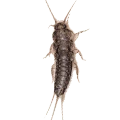
Silverfish are the UAE's quiet humidity pest. The tear-drop shaped, metallic-grey 12–18 mm insects move with a distinctive fish-like wriggle and hide in bathroom tile cracks, behind skirting, inside stored cardboard boxes and along the spines of bookshelves. They feed on starches and polysaccharides — book and box glue, photograph emulsion backings, stamp collection adhesive, fabric starch in stored linen, wallpaper paste, and the cellulose in cardboard itself. They do not bite, do not transmit disease, and pose no medical risk, but the damage to documents, books, photographs and natural-fibre clothing is permanent and silent. Newer Marina, JLT and Business Bay apartments are the worst-hit category in the UAE because high-rise floor-to-ceiling glazing combined with constant AC condensation produces ambient humidity well above the 55% threshold silverfish need to thrive — particularly in bathrooms and walk-in wardrobes where extractor fans run intermittently. Older Deira and Karama buildings see less silverfish pressure precisely because their AC systems run drier. PestMan combines residual dust application in skirting voids and behind tile, dehumidification guidance, cardboard storage replacement advice, and discreet sticky monitoring traps for ongoing detection — all backed by a 6-month pest-free guarantee with unlimited free call-outs.
Take moisture readings in bathrooms, walk-in wardrobes and storage rooms, then list the bookshelves, document boxes and tile-skirting joins that need treatment.
02
Dust & Crack Treatment
Apply residual silica/boric dust into skirting voids and grout lines — dry application that lasts 6–9 months in UAE humidity.
03
Monitor Traps & Humidity Plan
Place discreet sticky monitors at known harbourage points and brief you on bringing indoor humidity below 55% — the single biggest long-term control lever.
04
Follow-up & 6-Month Warranty
Free re-visit at day 30 to check monitor traps and refresh dust where needed, plus unlimited free call-outs across 180 days.
Service tiers
Our silverfish services
01
Residential
Apartment and villa programmes for bathroom, library and walk-in wardrobe silverfish clearance with humidity advice and a 6-month pest-free guarantee.
02
Libraries & Archives
Specialised treatment for private libraries, document archives, photography collections and gallery storage — non-chemical dust application around valuable items with documented humidity monitoring.
03
Commercial
Hotel guest room and storeroom programmes, retail back-of-house, school library service and government archive maintenance — quarterly inspection contracts.
silverfish control guide
Everything you should know
A short, honest field guide — what we look for, how we treat, and how to keep them out for good.
How to identify them
Tear-drop or carrot-shaped body, 12–18 mm long, metallic silver-grey scales reflecting light
Three distinctive long bristles trailing from the tail end, plus two long antennae from the head
Wriggling, fish-like side-to-side movement when running — completely unmistakable
Wingless and active at night — sightings during the day usually mean a heavy infestation
Tiny pepper-like droppings on bathroom shelves, inside book pages and at the back of cardboard storage boxes
Yellowish stain or scuff marks on book spines, photograph edges and starched linen — feeding damage
Signs of infestation
Silver-grey wriggling insect scuttling under a bath mat or out of a storage box when disturbed
Tiny pepper-like droppings inside bathroom cabinets, on book pages or in shoe boxes
Yellowish 'silverfish stain' marks on book spines and document edges where the glue has been eaten
Holes or chewed edges on stored cardboard boxes (especially old book or document storage)
Shed silverfish skins — translucent, near-transparent cuticles found in skirting corners
Faded or scuffed photograph emulsion on the back of framed photos hanging in humid rooms
Health & safety risks
No bite, no sting, no disease transmission — silverfish are medically harmless
Permanent damage to books, photographs, documents and stamp collections through glue and emulsion feeding
Cosmetic damage to natural-fibre clothing (cotton, linen, silk) that has been starched or stored long-term
Indicator of underlying humidity problem — silverfish presence flags conditions favourable to mould and dust mite growth
Cardboard box damage in stored archives, leading to structural collapse and content damage
Minor allergen exposure from shed skins in heavy infestations — relevant for severe dust allergies
Where you'll find them
Bathroom skirting cracks, behind tiles and inside vanity unit voids
Walk-in wardrobes and dressing room shelving — particularly the back wall area
Bookshelves and home libraries — silverfish eat the glue in book spines
Stored cardboard boxes in storage rooms, under-stair cupboards and storeroom shelving
Behind framed photographs, posters and wall-mounted artwork in humid rooms
Kitchen pantry corners where flour, starch and dry pasta are stored
Window sill cavities in newer high-rise apartments with floor-to-ceiling glazing
Peak population growth July to September during the wettest indoor condensation period
Reduced activity in dry desert winter air (December–February) for ventilated villas only
Newer high-rise apartments see no seasonal variation at all due to constant AC condensation
Our treatment approach
Residual dust application (boric acid or amorphous silica) in skirting voids, behind tile and inside vanity unit cavities — slow-acting, dry, ideal for humid environments
Crack-and-crevice gel placement around bathroom tile grout lines and behind kitchen kickboards
Discreet sticky monitor traps under sinks, behind bookshelves and in walk-in wardrobe corners for ongoing detection
Dehumidification consultation: target indoor humidity below 55% via dehumidifier or longer AC runs in problem rooms
Cardboard storage replacement guidance: swap to plastic snap-lid bins for stored documents, books and archived clothing
Inspection and treatment of bookshelf back panels and under-shelf voids where silverfish concentrate
Light residual perimeter on the outer wall side of window sills in floor-to-ceiling glazed apartments
Prevention tips
Keep indoor humidity below 55% — the single most effective long-term control across every silverfish scenario
Replace cardboard storage with sealed plastic snap-lid bins for documents, books, photographs and out-of-season clothing
Don't store photo albums, stamp collections or important papers in bathrooms, basements or storeroom corners — pick a dry interior room
Run bathroom and en-suite extractor fans for 30 minutes after every shower — single biggest source of high-humidity micro-environments
Inspect new cardboard deliveries (Amazon, IKEA flat-packs) for silverfish before bringing them inside — boxes are how silverfish travel into clean apartments
Schedule bathroom tile-grout repointing every 5–7 years — cracked grout is silverfish harbourage and a moisture-bridge route
Prep & aftercare
Before & after your service
Before your visit
Run bathroom extractor fans for at least one hour before the technician arrives — establishes the dehumidification baseline we'll work from
Clear the bathroom cabinet contents into a single dry box so the technician can dust behind the vanity unit and along the skirting
List the bookshelves, document boxes and walk-in wardrobe sections where you've actually seen silverfish or damage — saves inspection time
Move stored cardboard boxes 30 cm away from walls in storerooms and under-stair cupboards for inspection access
Bring framed photographs or books with visible silverfish damage into a single room for the technician to assess
Switch the AC in problem rooms to permanent ON (not auto) the night before — drier ambient air helps the dust adhere and lasts longer
After your service
Set bathroom AC fan to permanent ON for at least 1 week to drop ambient humidity below the 55% silverfish-comfort threshold
Replace cardboard storage with sealed plastic snap-lid bins — silverfish cannot eat polypropylene and you remove their food substrate permanently
Drop indoor humidity below 55% using a dehumidifier in the worst rooms or longer AC runtime — single biggest preventive control
Leave the residual dust UNDISTURBED in skirting voids and behind vanity units for 6 months — vacuuming or wiping it out kills the warranty
Check sticky monitor traps every 30 days and photograph captures via WhatsApp — we use the count to adjust dust placement at the day-30 visit
Inspect bookshelf spines and document boxes quarterly — early damage is reversible, late damage is not
The questions we hear most about silverfish control jobs in the UAE.
Silverfish have eaten the glue on my book spines — can the damage be repaired?
Partial repair is possible, full restoration usually is not. For modern paperback and hardback books with visible spine glue loss, a good local book binder in Karama or Sharjah can rebind the text block with fresh PVA adhesive for AED 80–250 per book — the result is structurally sound but the original spine printing is lost. For antique or rare books, consult a conservator before any glue work — wrong adhesive choice (especially anything acidic) accelerates deterioration of old paper. For photograph albums where silverfish have eaten the page glue, the photographs themselves are usually fine if removed quickly, but the original album binding cannot be replicated. The honest answer is: silverfish damage is far cheaper to prevent than to repair, which is why we lead every silverfish service with humidity advice rather than just spraying.
Will buying a dehumidifier actually solve the silverfish problem in my JLT apartment?
Yes, to a remarkable degree — humidity is THE controlling variable for silverfish. They cannot survive long-term below 55% relative humidity and they thrive above 75%. JLT, Marina and Business Bay apartments typically run at 65–80% indoor humidity in summer because the floor-to-ceiling glazing creates condensation faster than the AC can dehumidify it, and extractor fans run intermittently. A modestly-sized 12-litre/day dehumidifier (around AED 600–1,200 from any UAE appliance retailer) positioned in the worst-affected room (usually the master walk-in wardrobe or guest bathroom) dropping ambient humidity to 50% will reduce silverfish populations dramatically within 4–6 weeks. The dehumidifier alone won't eliminate an established population — you still need a residual dust treatment to kill the existing breeding adults — but it makes the treatment hold for years rather than months. We supply a humidity meter (hygrometer) free with every silverfish service.
Are the holes in my stored cashmere actually silverfish — or is it clothes moths?
Look at the location and the edge of the holes. Silverfish damage on natural-fibre clothing is concentrated on starched fabrics (cotton shirts, linen, kitchen napkins) and on heavily soiled areas — they're eating starch and sweat residue, not the fibre itself. The holes tend to be irregular shallow patches with frayed edges. Clothes moth damage on wool, cashmere and silk is concentrated on protein-rich keratin fibres and shows as small (2–8 mm) clean-cut holes, often with attached webbing or tiny cigar-shaped larval cases nearby. Cashmere with neat round holes and silky webbing is moth, not silverfish. Cotton starched shirts with shallow scuff damage are silverfish. Both pests are treatable but with different methods — moth uses pheromone traps plus targeted residual on the wardrobe, silverfish uses dust treatment and humidity control. We can ID from a photo before the visit.
I only see silverfish in the bathroom — can you treat just that room or do you do the whole apartment?
Bathroom-only treatment is available and works for the specific symptom, but it almost never holds long-term in JLT/Marina/Business Bay apartments because the underlying humidity problem affects the whole unit. What looks like a bathroom infestation is usually a bathroom HARBOURAGE feeding off whatever humid micro-environments exist elsewhere — typically the en-suite wardrobe, the storeroom, or behind a bookshelf on the opposite side of a shared wall. We offer a discounted single-room treatment if you genuinely only want the bathroom done, but our recommendation for high-rise apartments is the full apartment package: bathroom + bedrooms + storage + bookshelves, plus humidity baseline reading and a dehumidifier sizing recommendation. The price difference is around 30% and the result is night-and-day in durability. Villa clients in dry interior plots can usually do bathroom-only safely.
Do silverfish bite humans or pets?
No. Silverfish mouthparts are designed for scraping and chewing soft starches and polysaccharides — they physically cannot pierce human or pet skin. They don't sting, they don't transmit disease, and they have no defensive bite mechanism. Every 'bite' a UAE client has reported to us as silverfish has turned out to be one of three other things on close inspection: bed bugs (the most common misattribution), tropical rat mites carried in by rodents, or a contact dermatitis reaction from the silverfish's shed scales (which are mildly allergenic in very heavy infestations but cause itch, not bite marks). If you have a bite mark and silverfish in the same room, the bite is almost certainly from something else — and getting the correct ID matters because the treatments are completely different. Send a photo of the bite and a photo of any suspect insect before our visit and we'll ID before sending the technician.
What should I use instead of cardboard for long-term storage?
Sealed polypropylene snap-lid bins are the silverfish-proof choice and they're affordable across UAE retail — IKEA's SAMLA range, ACE Hardware's stackable bins, and Carrefour's own-brand storage boxes all work. The two design features that matter: (1) a fully snap-locked lid rather than a loose cover (silverfish can squeeze through any gap wider than 1 mm), and (2) opaque or smoked plastic rather than clear — light exposure also damages stored photographs and documents. For genuinely valuable archives (family photo collections, important documents, vintage books), add a packet of silica gel desiccant inside each bin and replace it annually. Avoid 'plastic' boxes that are actually cardboard with a thin plastic wrap (some cheap branded boxes are this) — silverfish eat through the wrap and reach the cardboard substrate inside. The cost is around AED 25–70 per bin for a typical Dubai apartment storage upgrade.
Can silverfish survive inside air-conditioning ducts or come through the AC?
No, and this is a useful piece of reassurance because the question comes up a lot. Silverfish need humid micro-environments and a starchy food source within walking distance — neither is available inside operating AC ductwork. Modern UAE building HVAC runs the supply air through a cooling coil that drops humidity to 30–40% before discharge, which is well below the silverfish survival threshold of 55%. The cool duct surfaces are also offer no food. So you won't get silverfish migrating from one apartment to another through the duct system, which is genuinely different from cockroaches and rodents that DO use shared building infrastructure. Where silverfish DO travel between units is through shared wall voids, plumbing penetrations and skirting gaps — particularly in floors where neighbouring apartments share a wet wall behind bathroom tile. That's why a brief inspection of the neighbouring apartment side wall is worthwhile if your infestation keeps coming back after treatment.
Are silverfish more of a problem in new builds or old buildings in Dubai?
Counterintuitively, new builds are worse — and the data from our last 18 months of UAE service calls confirms it. Newer high-rise towers in JLT, Marina, Business Bay and the Burj Khalifa district account for around 70% of our silverfish callouts despite holding maybe 35% of UAE residential stock. The reasons: (1) floor-to-ceiling glazing with poor secondary seals creates massive condensation surfaces, (2) AC systems are oversized for cooling but undersized for sustained dehumidification, (3) the tight building envelopes mean no passive ventilation to dry the indoor air, (4) walk-in wardrobes are a new build feature that's an ideal silverfish harbourage, and (5) new builds have more sealed cardboard packaging coming in (delivery boxes, IKEA flat packs, online retail) which is how silverfish initially arrive. Older Karama, Deira and Bur Dubai apartments see far less silverfish pressure precisely because their AC runs drier and ventilation is better. If you've recently moved into a new tower and started seeing silverfish, it's the building, not your housekeeping.