PestMan handles termite control in Sharjah with approval from Sharjah Municipality. Free quote in 30 minutes, same-day visits across the emirate, and a real warranty on every treatment.
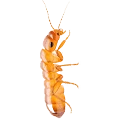
Termites are the silent disaster of UAE villas and townhouses. The dominant species in Dubai, Sharjah and Abu Dhabi is Heterotermes indicola — a subterranean termite that lives in soil colonies of 100,000+ workers, builds mud tubes up exterior walls and foundation joints, and consumes wooden door frames, skirting, kitchen cabinet carcasses, MDF wardrobes and roof timbers from the inside out. Damage is rarely visible until the wood has been hollowed out completely, by which point typical UAE villa repair bills run AED 50,000–150,000 in joinery and drywall replacement. Swarmer (alate) season runs March to May in Dubai — winged reproductives emerge at dusk after the first humid night and a 'storm' of them around a balcony light is the single clearest sign the building has an active colony nearby. PestMan's post-construction treatment uses a trench-and-flood Termidor SC (fipronil) or Premise (imidacloprid) chemical barrier around the villa foundation plus drill-and-inject treatment through skirting and tile gaps for active galleries — backed by a 5-year warranty (1,825 days). Pre-construction anti-termite (PCAT) pre-slab treatment with an 8-year warranty is handled by our pre-construction sector page.
Sharjah
Serving Sharjah
Sharjah villas with older drainage often need targeted cockroach gel-baiting at multiple access points. We schedule industrial-area warehouse visits before opening hours to avoid disruption.
Subterranean termites that silently consume villa joinery, doors and skirting — typical UAE damage runs AED 50,000–150,000 before discovery. Termidor soil-barrier treatment with a 5-year warranty.
Field guide
Signs you have an infestation
What our technicians look for first when they arrive at a Sharjah property.
Mud tubes on exterior boundary walls, garage walls or foundation skirting — even thin disused ones mean an active colony is within 20 m
Hollow tap-test response on a wooden skirting board, door frame or wardrobe carcass
Sudden sagging of an interior door that used to close cleanly six months ago
Pin-prick exit holes in skirting, often plugged with brown 'mud' from the inside
A dusk swarm of winged termites around an outdoor light between March and May
Piles of clear, even-sized wings on a window sill or pool deck after a humid evening
Scattered translucent wings on windowsills, balcony floors or near outdoor lights after a warm humid evening (March–May)
How we treat & prevent
Our approach in Sharjah
Treatment approach
Post-construction soil-barrier treatment: trench dug 30 cm wide × 30 cm deep around the entire villa foundation
Approved soil barrier (Termidor SC fipronil 9.1% / Premise 200 imidacloprid 21.4%) flooded into the trench around the foundation perimeter — typically 5 L per linear metre
Drill-and-inject technique on external walls: holes spaced 50–70 cm apart at a depth of 50–80 cm, deliberately avoiding electrical and plumbing service lines
Interior infested zones: four targeted holes drilled around each wooden door frame on the ground floor for direct gallery injection
Drill-and-inject treatment through tile grout lines and skirting boards at 30 cm intervals to reach the under-slab void
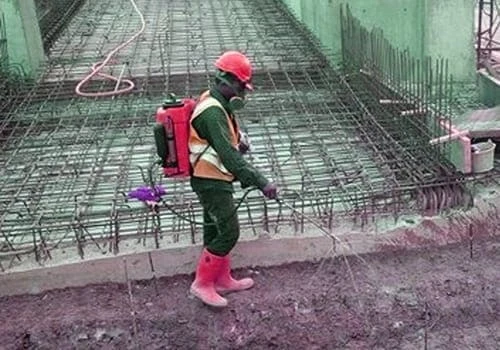
High-pressure pumps with calibrated tanks and specialised nozzles deliver even pesticide distribution and deep penetration into wood galleries
Direct injection into active mud tubes and exit holes with the same termiticide for in-gallery kill
Drilled holes are sealed afterward with cement colour-matched to the existing floor finish so aesthetics and tile lines are preserved
Wooden surface treatment with borate or permethrin on exposed roof timbers and pergola structures
Bait station rings (Sentricon-style monitoring stations) around villa perimeter for ongoing detection through the warranty period
Pre-construction PCAT (anti-termite under-slab spray with 8-year warranty) handled by the pre-construction sector page — cross-link only
UAE-specific prevention
Keep mulch, garden soil and bougainvillea root balls at least 30 cm clear of the villa exterior wall — termites travel through moist soil contact
Move stacked firewood, MDF offcuts and unused timber out of the garage and away from the villa — they're decoy food that draws colonies toward the building
Fix leaking AC condensate drips that pool against the foundation — wet soil is the strongest termite trigger in arid Dubai
Inspect the villa exterior once a year in March (just before swarm season) — walk the entire perimeter looking up the wall for mud tubes
If you renovate or extend the villa, request a fresh barrier treatment on the new footing before tile-down — the original 5-year warranty does NOT cover the extension area
Avoid direct soil-to-wood contact in garden landscaping — wooden decking should sit on concrete pads, not bedded in earth
Coverage in Sharjah
Termite Control across Sharjah
Same-day termite control call-outs across Sharjah's main communities.
Al Nahda
Al Majaz
Al Khan
Muwailih
Al Qasimia
Al Taawun
Industrial Area
Al Saja'a
Bu Tina
University City
FAQs
Frequently asked questions
The questions Sharjah customers ask most before booking termite control.
I'm about to buy a villa — should I get a termite inspection before signing the SPA?
Yes, and the reason is financial rather than dramatic. UAE home contents and building insurance policies explicitly exclude termite damage in almost every case, and a single missed colony in an established villa typically costs the new owner AED 50,000–150,000 in joinery, drywall and skirting replacement within 18–36 months. Our pre-purchase inspection takes 90 minutes — we survey every external wall for mud tubes, take moisture readings on all wooden door frames and skirting, do a hollow-tap test on every wardrobe carcass and a borescope inspection of the roof void where it's accessible. You get a dated, signed report ready for the SPA file. If we find activity, you have the leverage to negotiate either the treatment cost (typical AED 4,000–9,000 for a Dubai villa) into the price or a clean-bill certificate as a closing condition. We do not represent the seller in the inspection — only the buyer.
How do I tell a termite mud tube from an ant trail on my villa wall?
An ant trail is a moving line of visible insects walking on the wall surface — disturb them and they scatter. A termite mud tube is a built structure: a brown pencil-thick covered tunnel made of compacted soil, faeces and saliva running up the wall, usually starting at ground level and climbing toward wood. Scrape one with your fingernail and the surface flakes off to reveal the hollow tunnel inside — sometimes with pale workers moving within. Empty mud tubes are still significant: they mean a colony built them but is currently foraging elsewhere, and the colony itself is within 20 m underground. Take a clear photo and send it to us via WhatsApp before treatment — we can usually confirm species and urgency from the image alone.
What exactly is the drill-and-inject process — will it leave visible holes in my floor and walls?
Drill-and-inject is how we deliver termiticide directly into active galleries and the under-slab void where surface spraying can't reach. Around external walls we drill holes roughly 50–70 cm apart at a depth of 50–80 cm, carefully mapped to avoid electrical conduits and plumbing lines marked during the survey. Inside the villa we drill four targeted holes around each affected wooden door frame on the ground floor, plus injection points along tile grout lines and skirting at 30 cm intervals. We use high-pressure pumps with calibrated tanks and specialised nozzles so the termiticide spreads evenly and reaches deep into the gallery system. Once injection is complete, every hole is sealed with cement colour-matched to your existing floor finish — on a polished marble or porcelain floor the seal sits inside the grout line and is essentially invisible from standing height. We photograph each hole before and after sealing for your warranty file.
Do termites come back after Termidor treatment — what does the 5-year warranty actually cover?
Termidor SC creates a non-repellent chemical barrier in the soil around the foundation that stays effective for 7–10 years under normal UAE conditions. The 5-year warranty (1,825 days) is conservative: if termite activity reappears INSIDE the barrier perimeter at any point in the 5 years, we re-treat the affected zone free of charge. The warranty is voided only if: (1) the soil around the foundation has been excavated and replaced (e.g. landscaping work disrupted the barrier), (2) the villa has been extended without a fresh treatment on the new footing, or (3) untreated wooden material was installed in direct soil contact after the original treatment. We supply a copy of the barrier map and treatment certificate at completion — keep it with your title deed. Warranty claims are processed within 48 hours via WhatsApp with photos of the new activity.
I want to extend my villa next year — does the original termite warranty still cover the new extension?
No — and this is the most common warranty trap clients fall into. Our 5-year warranty covers the soil barrier we installed around the ORIGINAL villa footing. Any new extension has its own foundation, its own footing, and untreated soil under and around it. We strongly recommend a fresh barrier treatment on the extension footing BEFORE the new tiles are laid — the cost is dramatically lower (around 20–30% of an after-the-fact treatment) and you get an extended warranty merging the new zone with the original certificate. If you've already extended without treatment, we can still do an after-the-fact trench-and-inject around the extension perimeter — it's effective, just more disruptive. Either way, brief us during the planning stage rather than after handover from the contractor.
Do I need to vacate my villa during termite treatment — what about pregnant family members and infants?
No vacate is required. Fipronil (Termidor SC) and imidacloprid (Premise) are non-volatile soil-incorporated insecticides — they bind to soil particles in the trench and do not aerosolise. Once the trench is backfilled (within 4 hours of application), there is no detectable airborne residue inside the villa. We do recommend that pregnant women, infants under 12 months, and pets stay out of the immediate exterior trench zone for 24 hours simply because wet trench soil is messy and a toddler putting hands in it then into the mouth is the only realistic exposure path. Indoor drill-and-inject points are filled with mortar after injection so there's no surface residue. Drinking water tanks, swimming pools and pet water bowls don't need to be covered — the trench is below grade and laterally contained.
What does a typical post-construction termite treatment cost vs leaving the damage to grow?
Our post-construction Termidor SC trench-and-inject treatment for a 3-bedroom Dubai villa with a small garden is typically AED 4,000–6,500 depending on perimeter length and access. A 5-bedroom villa with a larger plot runs AED 7,500–11,000. That cost is one-time and carries a 5-year warranty. The alternative — letting an active colony continue — produces typical UAE damage figures of AED 50,000–80,000 for replacing interior doors and frames, AED 25,000–40,000 for kitchen and wardrobe MDF carcass replacement, and AED 15,000–30,000 for skirting and drywall remediation. Insurance won't pay. The financial maths argues for early treatment within 30 days of any positive sighting, not 'wait and see'. We can do a no-obligation inspection and same-day quote.
Carpenter ant damage looks similar to termite damage — how do you tell them apart?
Three diagnostic differences that an inspector confirms in 5 minutes. (1) Mud presence: termite galleries are packed with mud-and-faeces shelter tubes; carpenter ant galleries are clean, smooth and sandpapered-looking with no mud. (2) The discarded debris below the nest: termites discard nothing visible from outside; carpenter ants push fine sawdust ('frass') out of small slit holes in the wood, building a pile of pale wood shavings below the nest opening. (3) Live worker appearance: if you break open a gallery, termites are pale white workers with straight antennae and a fat body; carpenter ants are dark, bent-antennae, with a thin waist between thorax and abdomen. Treatments are entirely different — termites need soil-barrier termiticide, carpenter ants need void-dust insecticide injected into the gallery. Wrong diagnosis means wrong product means wasted money.
Will my UAE home insurance cover termite damage if I don't have current treatment?
Almost certainly no. Every major UAE home buildings and contents insurer (the established names underwritten through Dubai-based brokers) explicitly excludes 'damage caused by insects, vermin, woodworm and termites' from cover — it's a standard policy carve-out across the GCC market. Even a comprehensive contents policy that covers theft, fire and accidental damage will turn down a termite claim. The only effective protection is preventive: a current Termidor barrier with documented annual or 5-yearly inspection. The insurance reasoning is that termite damage is gradual, foreseeable and preventable — it's treated like rust or rot, not a sudden insurable event. Some commercial property policies have a 'pest damage' rider available for an extra premium, but residential insurers generally don't offer one. Treatment is the cover.
Need help today?
We're one call from your door.
Free quote in 30 minutes. Same-day visits across Dubai, Sharjah, Abu Dhabi & every other emirate.